Jakarta, January 13, 2026 – Village administrations are currently facing increasingly complex demands. Heavy administrative workloads, the need for rapid public services, and the requirement to formulate accountable policies make improving the competence of village officials an urgent necessity. Another factor supporting the improvement of village officials' competencies is the completeness of data foundations. Without a strong data foundation, the planning and implementation of village development processes risk being misdirected.
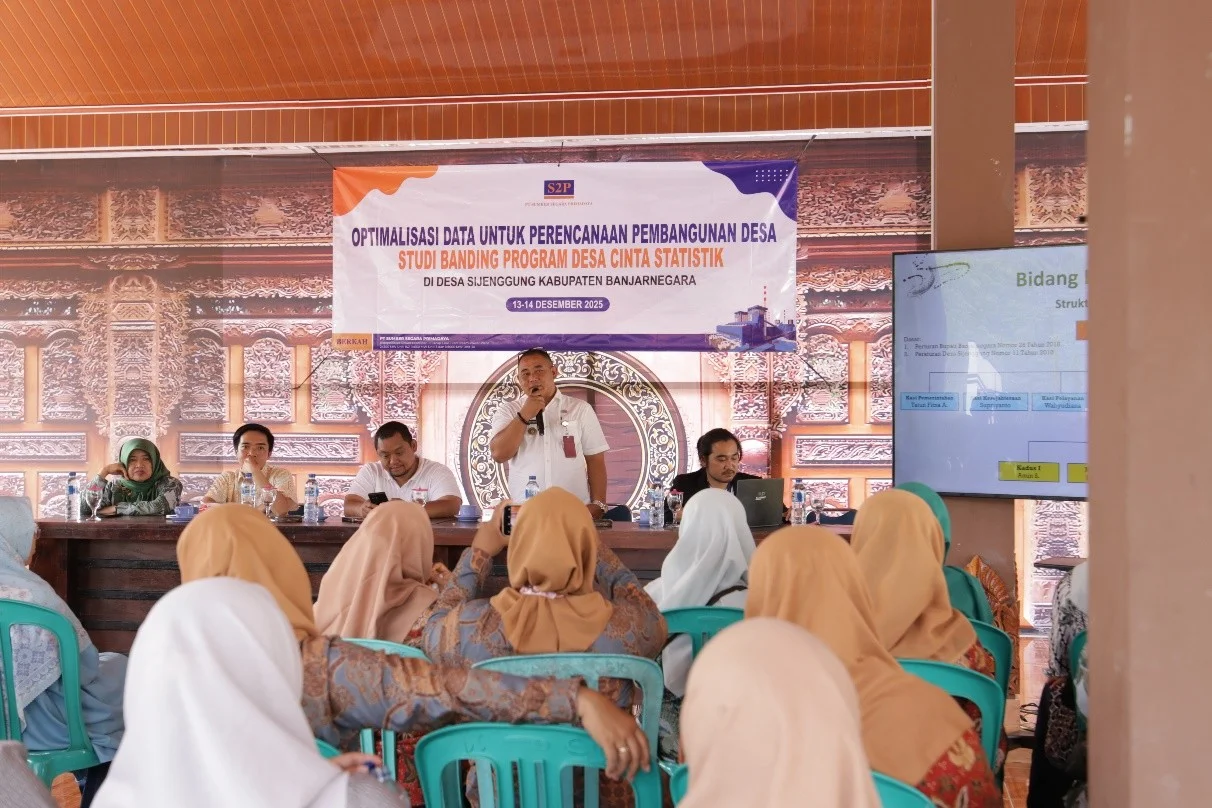
In response to these challenges, PT Sumber Segara Primadaya (S2P) – Cilacap PLTU organized the “Training and Comparative Study Program for Village Officials in Sijenggung Village.” This program was designed to strengthen village data management, while ensuring that every development and budget decision can be implemented in a measurable, transparent, and relevant manner to the needs of the residents.
The program was attended by village officials from Menganti, Karangkandri, and Slarang villages. Activities included training on the use of the village data website, namely an introduction to the digital data compilation system; focus group discussions (FGD); and hands-on learning through comparative studies in Sijenggung Village.
Through a comparative study to Sijenggung Village, participants learned firsthand about the implementation of the Desa Cinta Statistik (Desa Cantik) program, including the application of village data digitization, which has been proven to improve the quality of public services, administrative efficiency, and the ease of work for village officials. During this activity, participants also received an overview of the parameters of a good Village Information System (SID), including the completeness and accuracy of population data, poverty and vulnerable group data, village economic potential, basic services, and data integration with village SDG indicators. In addition, the importance of data updates, ease of access, information security, and data utilization in village planning, budgeting, and reporting was also emphasized.
The series of activities was complemented by a Focus Group Discussion (FGD) that discussed lessons learned from comparative studies and the preparation of plans for data digitization implementation in their respective villages. In this session, village officials showed great enthusiasm for adopting a more orderly, integrated, and sustainable data management system.
Sijenggung Village was chosen as a comparative study location because it has a strong track record in implementing data-based village governance through the Desa Cinta Statistik (Desa Cantik) program. This is reflected in the consistency of population data updates, the use of Village SDG data in planning and budgeting, and the openness of public information. For these best practices, Sijenggung Village has received various awards at the national and regional levels.
Strengthening the Foundation of Data-Based Village Governance
Through the “Training and Comparative Study Program for Village Officials in Sijenggung Village,” the competence of village officials is improved through a practical approach based on everyday issues in the field. PT S2P management emphasized that this program is part of the company's commitment to continue to grow and progress together with the community. “Good village data management is an important foundation for sustainable and inclusive development. Through this program, we want to encourage the villages we assist to be able to plan data-based development, so that the benefits are truly felt by the community and are in line with the achievement of the SDGs,” said Zam Zam Nurjaman, LK3 & CSR Manager of PT S2P.

The village data prioritized in the program includes population data (number of residents, age, gender, education, occupation, and socioeconomic status); poverty and vulnerable group data; village economic potential data, such as MSMEs, agriculture, livestock, and local labor; infrastructure and environmental data; and basic service data, such as health, education, and social services, which are linked to the Village SDGs indicators.
This data is often scattered and difficult to access, which can hinder planning. This training program aims to make the data more structured and directly linked to the budgeting process. The S2P program emphasizes that village budgeting can only be effective if it is supported by up-to-date and easily accessible data. Therefore, participants are trained to understand the workflow from data collection to its utilization in planning documents.

Zam Zam Nurjaman further stated that improving the competence of village officials is not only a short-term investment, but also part of efforts to build strong and adaptive village governance. “As part of its CSR program, PT S2P is committed to continuing to assist communities and village governments so that they can develop independently, transparently, and sustainably,” he added.
PT Sumber Segara Primadaya (S2P) – Cilacap Power Plant invites village governments, local institutions, and stakeholders to participate in the next training and comparative study program. By learning together and applying best practices, villages can improve the competence of village officials, strengthen governance, improve public services, and build trust through data-driven decisions. The event concluded with an outbound session aimed at strengthening cooperation, unity, and the spirit of collaboration among village officials as a single development team.